Quick answer: Doctrinal drift is when AI-written church content slowly moves away from what your church believes, usually through small word choices rather than big mistakes. It happens because generic AI learns from the whole internet, not your statement of faith. The safest church AI tools prevent drift by building your beliefs and AI policy into every prompt.
This is part of our series on picking the safest AI for churches.
Drift is quiet, not loud
Most people worry AI will say something outrageous. That is rare. The real risk is quieter. AI tends to write in the most common, middle-of-the-road language it has seen. For a church, that means:
- "Faith journey" instead of the gospel language your church uses
- "Higher power" or "the universe" slipping into a devotional
- Grace described as "being kind to yourself"
- Easter framed as "new beginnings" with no mention of the resurrection
- A verse quoted from a translation you do not use, or one that does not exist
None of these feel like a crisis on their own. But over months, your communications start to say less than your pulpit does. That is drift.
Why generic AI drifts
Tools like ChatGPT are trained to be helpful to everyone. They try to avoid taking sides. That is fine for a recipe. It is a problem for a church with clear convictions. When the AI does not know your beliefs, it picks the safest-sounding words for a general audience. Those words often blur what you actually teach.
AI can also "hallucinate," which means it makes things up with confidence. It may invent a Scripture reference, misquote a well-known pastor, or get a detail about your church wrong.
Where drift shows up most
- Sermon recaps — the main point gets softened or generalized.
- Holiday campaigns — Christmas and Easter lose their center.
- Social posts on hard topics — AI adds opinions your church has not taken.
- Devotionals and newsletters — vague spiritual language replaces clear teaching.
- Ads — copy sounds like a wellness brand instead of a church.
How to stop doctrinal drift
1. Give the AI your statement of faith, every time
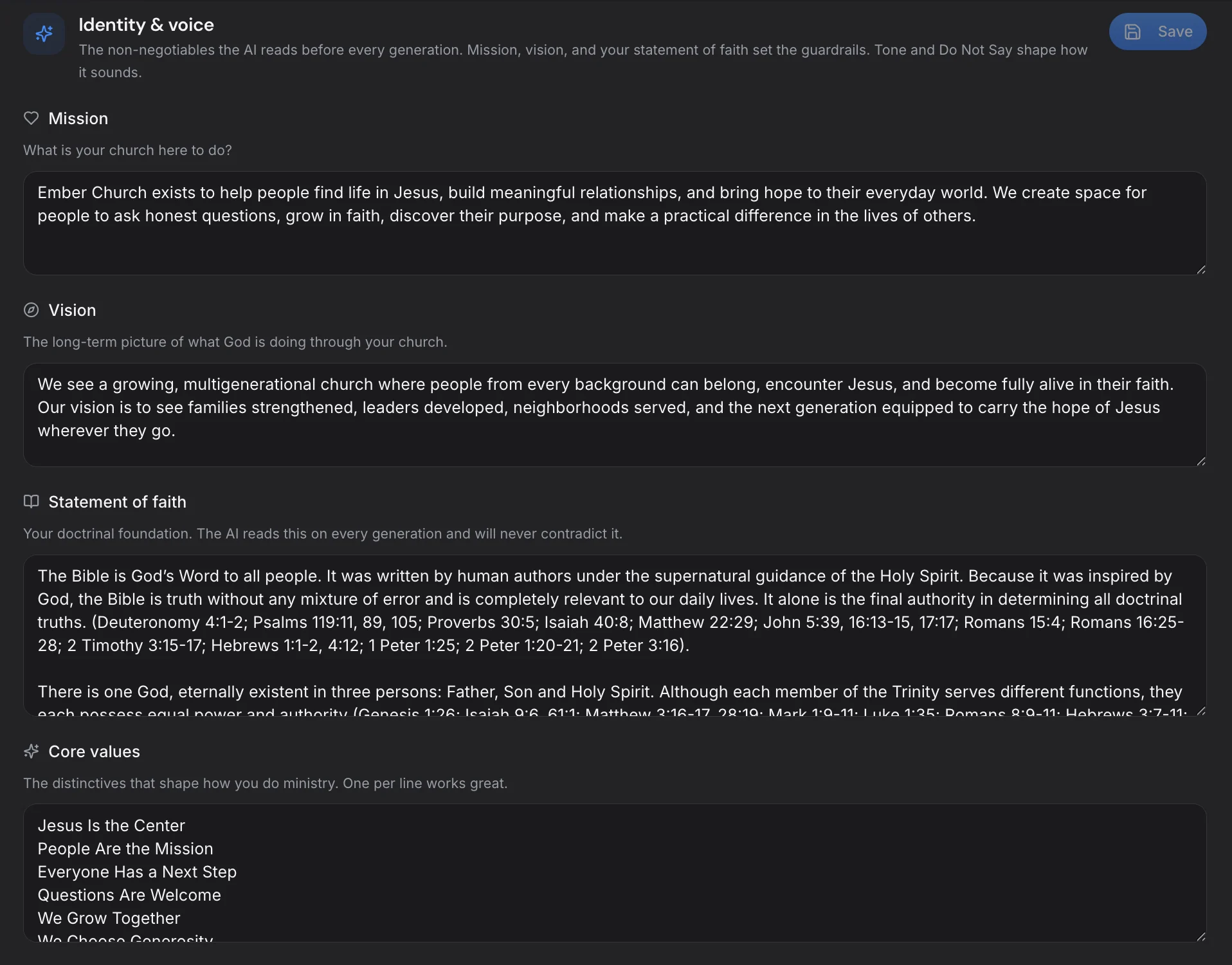
The AI cannot follow beliefs it does not know. In ChurchCopy, your statement of faith, mission, vision, values, and tone are saved once and included in every prompt automatically.
2. Set theological boundaries in your AI policy
List the topics that need pastor review and the lines AI should never cross. ChurchCopy's AI Policy & Guardrails make those boundaries part of every answer. Read more in our article on theological boundaries for church AI.
3. Lock your Scripture rules
Pick your translation and tell the AI how to handle verses. Always check references before publishing.
4. Keep a human in the loop
No AI should publish church content alone. Use review and approval so a staff member or pastor signs off. See our guide to human-in-the-loop review.
5. Use one tool for everyone
Drift multiplies when each person uses a different AI. One shared workspace means one set of beliefs behind every word.
Same easy chat, without the drift
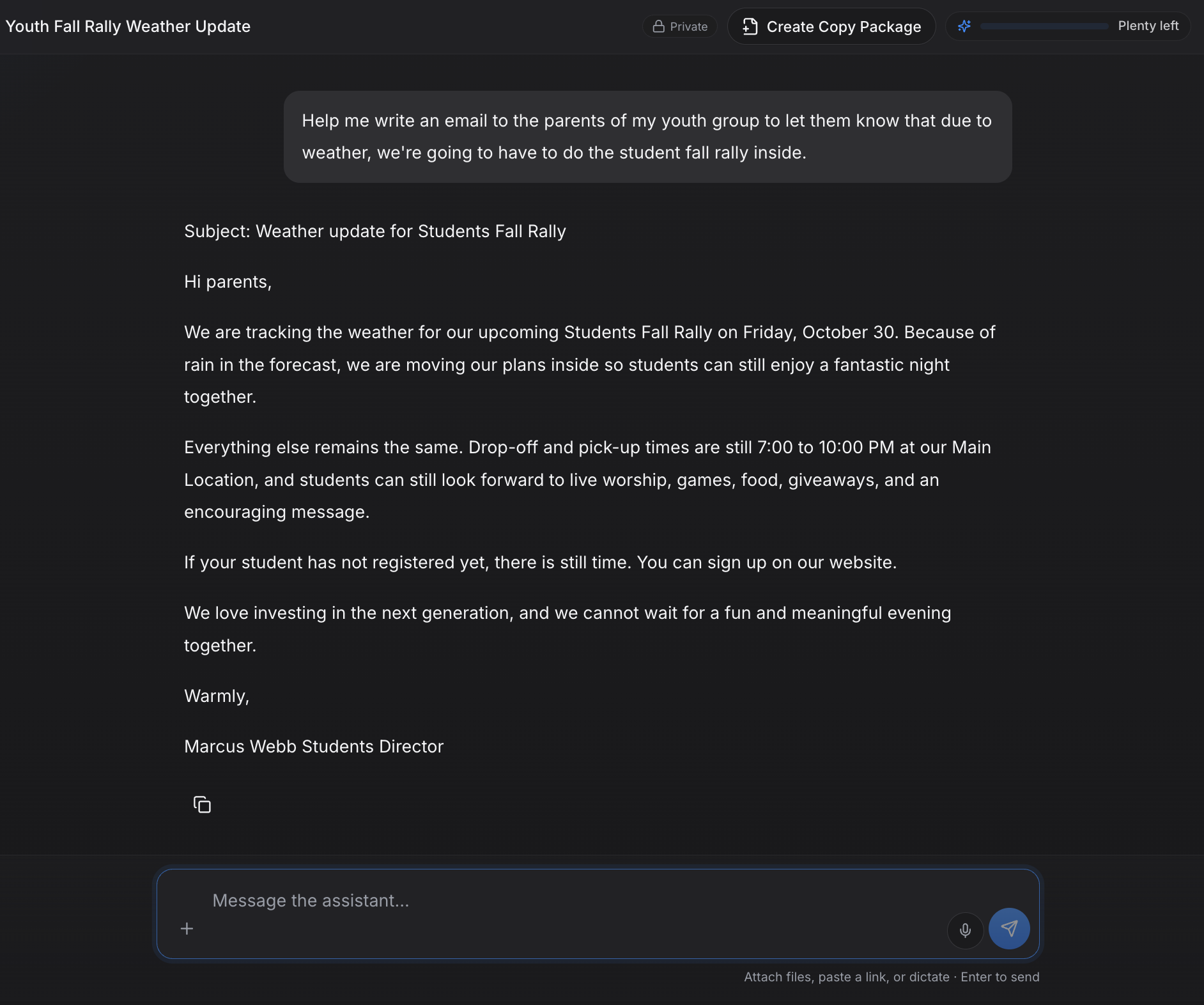
Your team can still chat with AI. ChurchCopy's AI Chat Assistant feels like ChatGPT, but every answer starts from your church's settings. Ask it for an Easter invite and it writes from your beliefs, not the internet's average.
Protection that costs less than ChatGPT
ChurchCopy is $29 per month for the first seat and $10 for each extra seat. A team of four pays $59 per month, compared to about $80 for four ChatGPT accounts that know nothing about your doctrine. Unlimited free viewers are included. See pricing.
A quick drift check for your team
Pull five recent AI-assisted posts and ask:
- Would our lead pastor say it this way?
- Does it use our words, or generic spiritual words?
- Are the Scripture references real and in our translation?
- Does it take any stance we have not taken?
If you find drift, it is not your team's fault. It is a sign your AI does not know your church yet.
The bottom line
Doctrinal drift happens one soft word at a time. The fix is an AI that knows what you believe and follows your policy on every prompt.
Try for free and keep every message true to your church.