Quick answer: The best AI for a church is the safest AI for a church. That means a tool where leadership sets an AI policy and guardrails once, and every prompt from every staff member follows them. Most "best AI for churches" lists skip this completely. They rank tools on speed, templates, and price. But speed without guardrails is a risk, not a feature.
If you have searched for "best AI for churches" lately, you have seen the lists. Ten tools. Twenty tools. Star ratings and screenshots. Many of those tools are good at what they do. But almost none of the lists ask the question church leaders should care about most: who decides what the AI is allowed to say for your church?
This guide explains the trap, why every church needs an AI policy, and what to look for so you choose a tool that is safe first and fast second.
The trap: judging church AI like any other software
A marketing agency can judge AI on output. More posts, faster, cheaper. A church cannot. Your words carry your doctrine, your pastoral care, and your reputation in your town. One careless post can confuse a new believer, hurt a grieving family, or say something about Scripture your elders would never approve.
So when a list calls a tool the "best AI for churches," ask what it measured. Usually it is:
- How fast it writes
- How many templates it has
- How cheap it is per month
Those matter. But they are the second question. The first question is safety. That is why we think churches should stop searching for "best AI tools for churches" and start searching for the safest AI tools for churches.
The rogue prompt problem: five people, five ChatGPT tabs
Here is what AI looks like in most churches today. The communications director uses ChatGPT. The youth pastor uses it too. So does the kids ministry lead, the worship pastor, and a volunteer who helps with social media. Each one opens a blank chat and types a prompt.
What comes back sounds like five different churches:
- The youth post is loud, slangy, and full of emojis.
- The kids ministry email sounds like a school district memo.
- The worship invite uses words your church never uses.
- The volunteer's post about a hard topic takes a theological stance your elders have never discussed.
That last one is the real danger. Sooner or later, someone goes rogue. Not on purpose. They just ask a blank AI for help, and the AI fills the gaps with its own guesses. It does not know your statement of faith. It does not know you avoid politics from the pulpit. It does not know that prayer requests are private. It starts from zero every single time.
Generic AI is not built to protect your church. It is built to answer whatever it is asked.
Why every church needs an AI policy
An AI policy is a short set of rules your leadership agrees on for how AI is used in your church. A good church AI policy covers:
- What AI can help with — event promotion, newsletters, social posts, emails.
- What AI should never handle alone — pastoral care, counseling, grief, church discipline, and sensitive personal stories.
- Doctrinal boundaries — your statement of faith and topics that need pastor review.
- Scripture handling — which translation you use and how verses are quoted.
- Privacy — never putting names, prayer requests, or member data into AI.
- Human review — a real person approves content before it goes out.
- Disclosure — when and how you tell people AI helped.
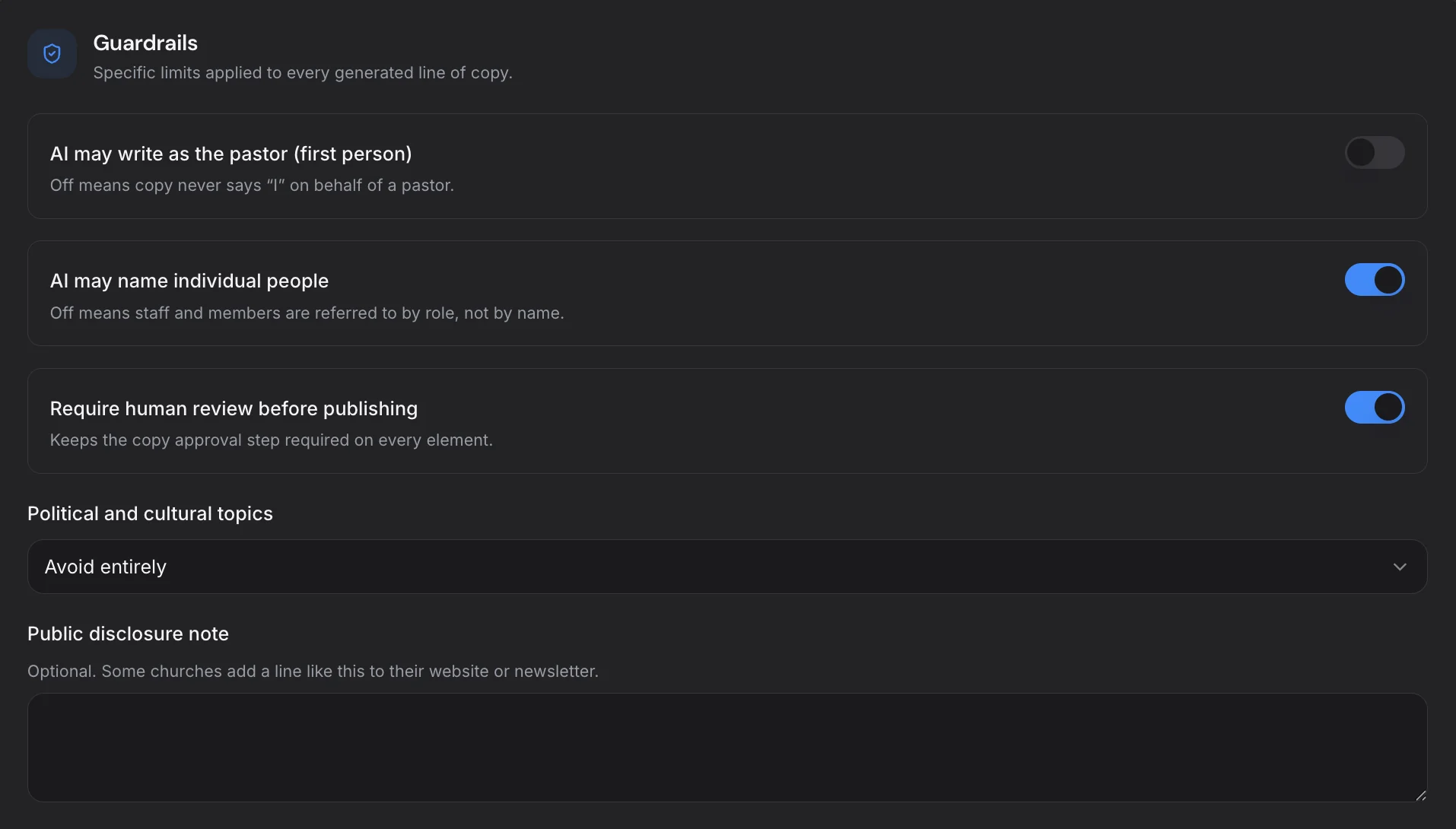
You can see how ChurchCopy turns these rules into settings on our AI Policy & Guardrails page. But writing the policy is only half the job.
Why a PDF policy is not enough
Many churches write a policy, approve it at a board meeting, save it as a PDF, and move on. Then Thursday comes. The bulletin is due. A volunteer is in a hurry. Nobody opens the PDF.
A policy that lives in a folder does not protect anyone. A policy has to live inside the tool, where the writing actually happens. That is the single biggest difference between a generic AI tool and a safe one.
Here is the test: if a brand-new volunteer typed a prompt into the tool today, would your policy shape the answer? With ChatGPT, the answer is no. With a tool that has an AI policy built in, the answer is yes.
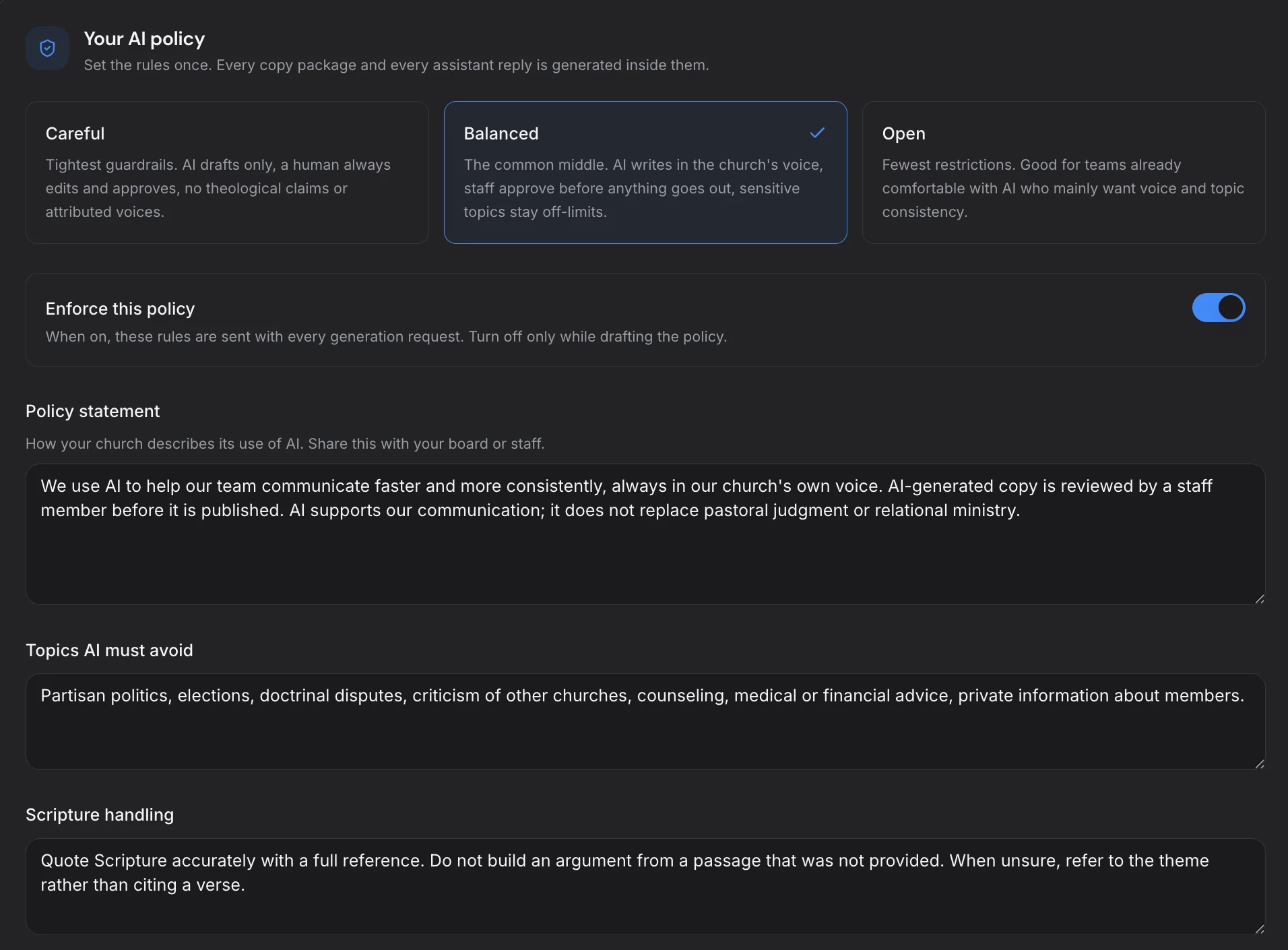
How ChurchCopy makes AI safe for churches
ChurchCopy was built for this exact problem. Before your team writes anything, your church fills in its settings:
- Mission and vision
- Core values
- Statement of faith
- Desired tone of voice
- Your AI Policy and guardrails
Then ChurchCopy bakes those settings into every AI prompt. It does not matter who on your team is writing. It does not matter if they are on staff or a volunteer. Every copy package and every AI Chat conversation starts by reviewing your church's settings first. Nobody has to remember the rules, because the tool already does.
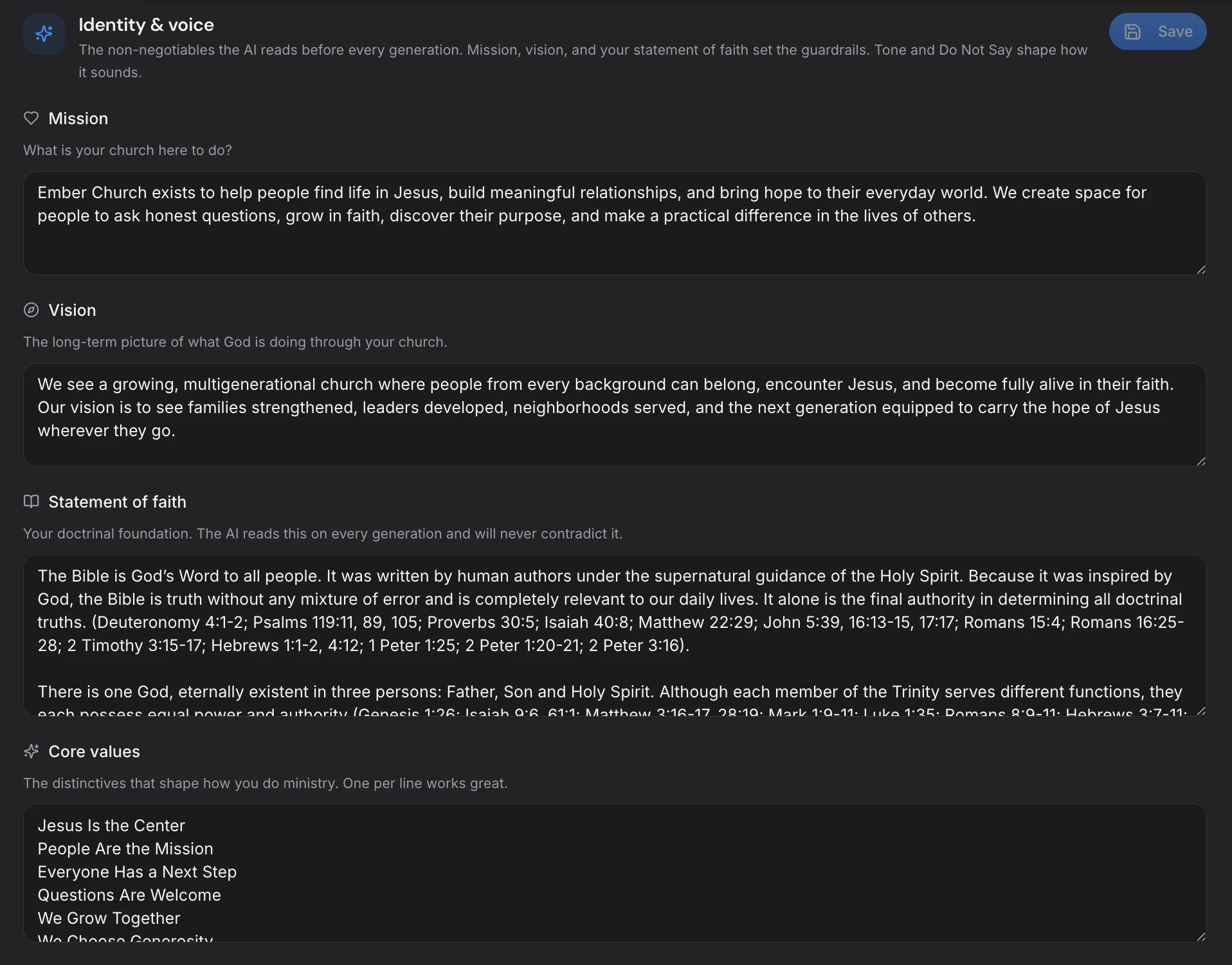
That is what makes ChurchCopy one of the safest AI tools on the market for churches. You never have to train it. You never start with a blank prompt. And nobody can quietly drift away from what your church believes.
Yes, it has an AI chat like ChatGPT — built for churches
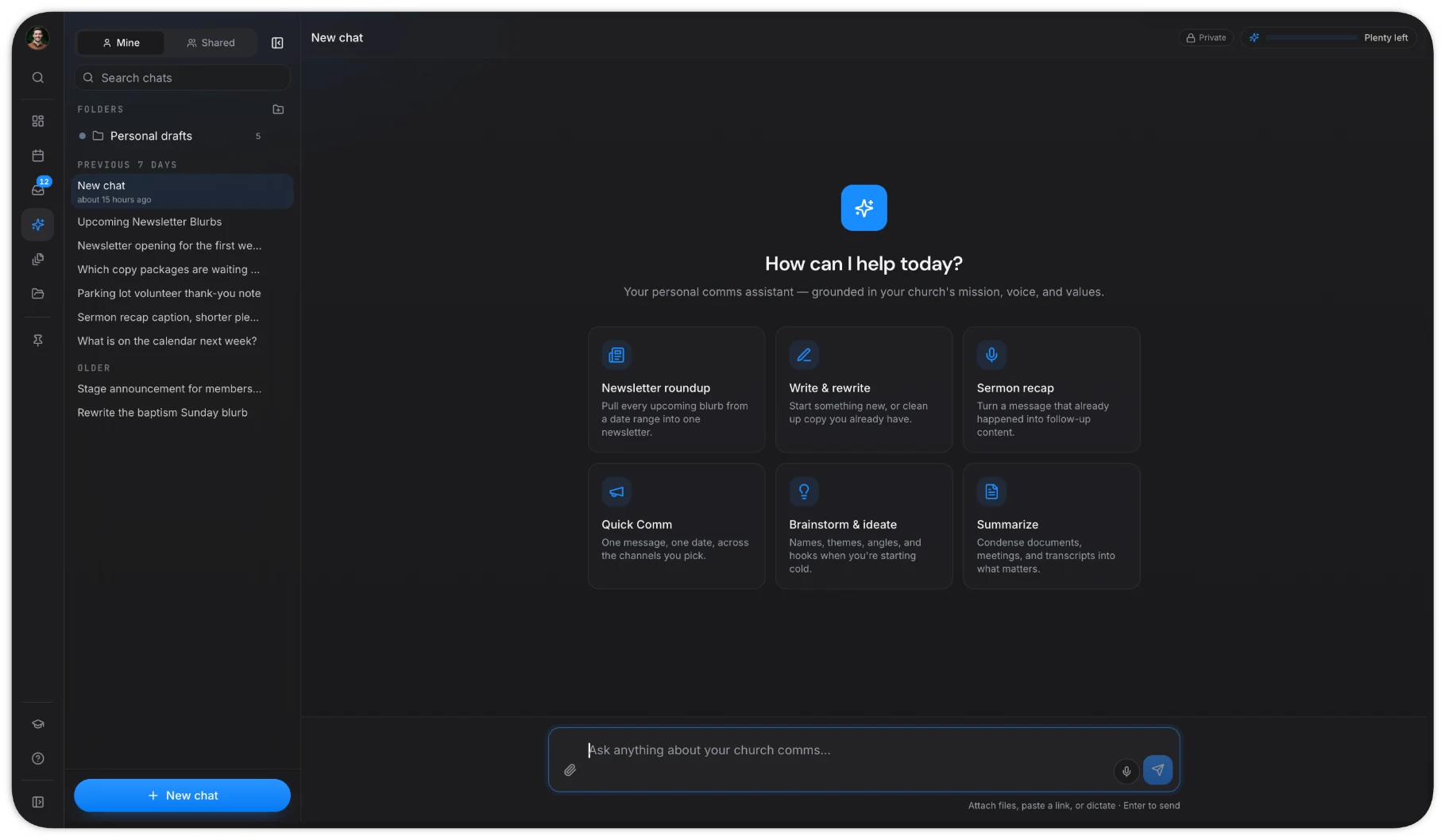
Your team does not have to give up the easy back-and-forth of ChatGPT. ChurchCopy has its own AI Chat Assistant. Ask it to draft a welcome email, brainstorm sermon series titles, write a newsletter blurb, or find what needs to go out this week.
The difference is that it already knows your church. It answers inside your guardrails. If someone asks it to cross a line your policy blocks, it stays in bounds. It is the same easy chat experience, without the risk of going rogue.
Safer, and cheaper than ChatGPT for your whole team
Here is a surprise for many churches: the safe option is also the cheaper one for teams. A paid ChatGPT plan costs about $20 per person per month. Every person pays the full price, and every account is separate, with no shared settings.
ChurchCopy is $29 per month for the first seat and only $10 per month for each extra seat. Unlimited free viewers can view and copy finished content.
- 3 people: ChatGPT about $60/mo. ChurchCopy $49/mo.
- 5 people: ChatGPT about $100/mo. ChurchCopy $69/mo.
- 10 people: ChatGPT about $200/mo. ChurchCopy $119/mo.
The more people on your team, the more you save. And you get your AI policy, guardrails, copy packages, a shared calendar, and team review on top. See the full details on our pricing page.
A 6-point safety checklist before you pick any church AI tool
There are many AI tools being built for churches right now. Before you choose one, ask these six questions:
- Does it have an AI policy generator built in? If not, your policy stays in a PDF.
- Does it save your statement of faith and values? And does it use them on every prompt?
- Can leadership control the guardrails? Or can any user change them?
- Does it protect sensitive topics? Pastoral care and hard topics need a human.
- Does the chat follow the same rules as everything else? A safe tool has no back door.
- Does it support team review? Content should be approved before it ships. Learn more about review and approval.
If a tool fails the first question, it is not the safest choice, no matter how high it ranks on a list.
What is coming in this series
This article is the hub of a new series on safe church AI. Every week we will go deeper:
- The rogue prompt problem: why separate ChatGPT accounts break church messaging
- Built-in guardrails vs. PDF policies
- Doctrinal drift: how generic AI quietly changes your message
- An executive pastor's evaluation guide for church AI tools
- The real cost of ChatGPT for a church team
Stop searching for the best. Start choosing the safest.
AI is changing how churches communicate, and that is a good thing. Your team can do more with less stress. But the most important part of using AI in a church is not speed. It is making sure your AI policy and guardrails are in place, and that every prompt follows them.
ChurchCopy puts your mission, vision, tone, and AI Policy inside every prompt, so your whole team sounds like one church and never goes rogue. Explore the AI Policy & Guardrails feature to see how it works.
Try for free and see what safe church AI feels like.